

Long-Tailed vs Pig-Tailed Macaques: Just How Different Are They?


My personal observations from working with macaques at a rescue centre in Java, Indonesia.
I've spent a fair amount of time working with macaques over the last couple of years, and one thing I've come to realise is that whilst they might all belong to the same family, they certainly don't all behave in the same way.
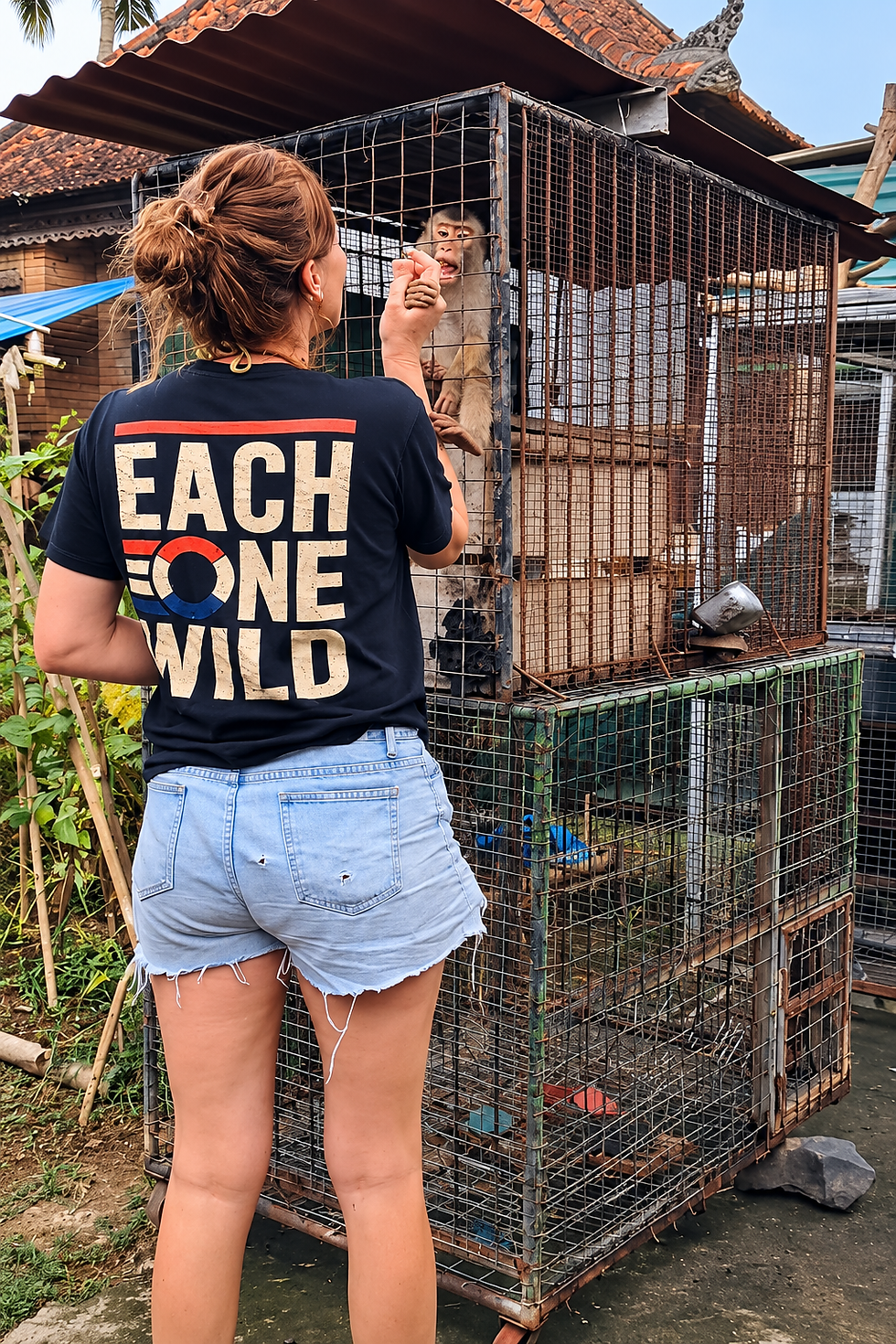
Here at our rescue centre in Java, we have a group of long-tailed macaques and just one pig-tailed macaque, an adult male called Encon. And I've been finding it really interesting to observe the differences between him and the others.
Before I go any further, I want to make something clear. I'm not writing this from a scientific perspective. I haven't spent hours researching the behavioural differences between these species, and I'm certainly not claiming to be an expert on the subject. These are simply my own observations from spending time with the animals in our care. I'm also very aware that Encon is just one pig-tailed macaque, so his behaviour might be more about his individual personality than his species. But nevertheless, there are some differences I've noticed that I thought were worth sharing.
First of All, the Size!
The first and most obvious difference is the sheer size and power of a pig-tailed macaque. Now don't get me wrong, I have absolutely no desire to get into a fight with a long-tailed macaque. Even the smaller ones can be pretty feisty little buggers, and they have some rather impressive canine teeth that they're not afraid to use!
But wow. Our Encon is something else entirely.
He's around twice the size of our largest male long-tailed macaque, and he is absolutely solid. I'm not exaggerating when I say this guy looks like he bench presses seven days a week. He's just pure muscle, and the thought of being on the receiving end of an attack from him is genuinely quite frightening.
Of course, size isn't everything, and a smaller macaque can still do an enormous amount of damage. But there's something about Encon's physical presence that makes you particularly aware of just how powerful these animals can be.
Do Pig-Tailed Macaques Think Before They Act?
Now this is where things get a little more interesting, and I'm not entirely sure how to explain what I've noticed.
Our long-tailed macaques seem to be incredibly reactive animals. Something happens that they don't like, and their response can be almost immediate. It's very much a case of attack first, think later. Or at least that's how it appears to me.
Encon, on the other hand, seems to be a little more thoughtful about things. I get the impression that there is more consideration behind his actions. If something annoys him, he appears to take a moment to assess the situation before deciding how to respond.
Now, don't misunderstand me. He might still decide that attacking you is the most appropriate course of action. But at least he seems to have taken a split second to make his mind up first!
I honestly don't know what I'm basing this impression on. It's not as though I can see what's going on inside his head. And perhaps the long-tailed macaques are making exactly the same assessments, just much faster than I can recognise. But there is something about Encon's behaviour that feels more deliberate, whereas the long-tails often seem to respond purely on impulse.
Whether this is a genuine difference between the species or simply a difference between the individuals I'm working with, I really couldn't say. It's just something I've noticed.
The Unpredictable World of Long-Tailed Macaques
One thing that never ceases to amaze me about long-tailed macaques is just how quickly their behaviour can change.
I've honestly never worked with another animal quite like them.
One minute you can be having the most lovely, tender moment with a long-tailed macaque. They're sitting beside you, gently grooming your hair, carefully picking through it with their little fingers, and you're thinking how wonderful it is that this wild animal has chosen to show you some affection.
And then, seemingly out of nowhere, the monkey decides that actually, he hates you.
And naturally, the appropriate course of action is to start pulling your hair out by the roots whilst attempting to bite you.
It's quite extraordinary how quickly things can change!
Now, I'm sure there are reasons behind these sudden reactions. Macaques communicate in ways that we humans don't always recognise, and what seems completely random to me might make perfect sense to another monkey. But from a human perspective, their behaviour can sometimes be incredibly difficult to predict.
Encon doesn't seem to have quite the same dramatic changes in his behaviour. He appears to be much more consistent in the way he responds to different people, which brings me rather neatly to our relationship.
Or lack of one.
Encon Doesn't Like Me. That's Just a Fact.
I've come to accept that Encon doesn't particularly like me.
He's not aggressive towards me, and I wouldn't say he has a problem with me being around. He just doesn't seem especially interested in my existence. Unless, of course, I happen to be carrying food. Then suddenly I'm worth acknowledging!
I genuinely don't think he'd mind one bit if he never saw me again.
But what's interesting is that there are other workers at the centre whom he seems to have a real affection for. He'll actively seek out their attention, snuggle up to them and clearly enjoy being close to them.
And from what I've seen, these relationships are pretty consistent. He doesn't seem to suddenly change his mind about who he likes and who he doesn't. The people he's affectionate towards remain the people he's affectionate towards, and the people he isn't particularly interested in remain exactly that.
This seems quite different from my experiences with some of our long-tailed macaques, whose attitude towards you can apparently change in the space of about three seconds.
Sadly, I suspect this means Encon and I are never going to have a particularly close relationship. Although I'm not completely ruling out the possibility of buying his affection with food!
They Sound Completely Different Too
Another really noticeable difference is the sounds they make.
Our long-tailed macaques have what I can only describe as quite an extensive vocabulary. They make all sorts of different noises, and after spending enough time around them, you start to recognise certain sounds and what they might mean.
There are the fast, aggressive grunts when they're upset about something or threatening another monkey. There are little chirping noises, and those rather lovely drawn-out "oooooh" sounds that seem to be particularly common when food is on the way. And then, of course, there are the high-pitched screams, especially from the younger monkeys.
Sometimes the noise coming from a group of long-tailed macaques is quite something!
Encon, however, seems to have a much more limited range of sounds. Or at least he does when I'm around.
He generally just grunts.
If he's curious about something or relatively relaxed, he'll make these slow, deep grunting noises. If something upsets him, the grunts become faster and more intense. But I've never heard him make the little chirps, squeals or high-pitched calls that are so common amongst our long-tails.
Now, whether this is a difference between the species, a result of Encon's individual personality, or something to do with the fact that he's living in captivity without other pig-tailed macaques, I really don't know.
I'm certainly not suggesting that pig-tailed macaques are incapable of making other sounds. I'm simply saying that in the time I've spent with Encon, these deep grunts are pretty much all I've heard from him.
And to be fair, they do suit him rather well.
But Neither Species Should Ever Be Kept as a Pet
Despite all these differences, there's one very important thing that long-tailed and pig-tailed macaques have in common.
Neither of them makes a suitable pet.
And this is something I feel very strongly about.
Unfortunately, the wildlife pet trade is still a huge problem here in Indonesia, and macaques are regularly bought and sold, often for surprisingly little money. It's heartbreaking because I can understand exactly why people are tempted to buy them.
Baby macaques are absolutely adorable. They're tiny, playful, affectionate and incredibly expressive. It's very easy to look at one and imagine having this wonderful little companion who will love you forever.
But here's the problem. They don't stay babies for very long.
And what you've actually bought isn't a cute little companion. You've bought a wild primate.
Macaques cannot be domesticated simply by raising them around humans. As they grow older, they become stronger, more independent and often much more difficult to manage. They have powerful teeth, complex social needs and natural behaviours that can make them extremely challenging, and sometimes dangerous, to keep in a domestic environment.
They're also incredibly destructive. And I really do mean incredibly!
Both species need specialist care, appropriate environments, proper enrichment and people who understand their behaviour. Even those of us who work with macaques regularly have to be extremely careful around them.
And sadly, what often happens is that somebody buys an adorable baby monkey, enjoys having it whilst it's small, and then finds themselves completely unable to cope when it grows into a powerful adult.
The monkey might then spend years chained up, confined to a tiny cage, sold to somebody else or simply abandoned.
And all because somebody wanted a cute pet without understanding what they were taking on.
It's one of the reasons I feel so strongly about the work we do at Bali Monkey Rescue. These animals deserve so much better than that.
So, Are They Really That Different?
Well, from my own experiences, I'd say yes. At least the individuals I'm working with certainly seem to be.
Our long-tailed macaques are incredibly reactive, vocal and sometimes wonderfully affectionate, although that affection can disappear rather quickly if you happen to do something that offends them.
Encon, meanwhile, seems more deliberate in his behaviour, more consistent in his relationships and considerably less interested in having long conversations with anyone.
He's also built like a professional bodybuilder, which is worth remembering!
But I think the most important thing I've learned from working with primates is that every single one of them is an individual. They all have their own personalities, preferences, experiences and ways of interacting with the world.
And the more time I spend around them, the more I realise how much there still is to learn.
As for Encon, I'm going to keep trying to win him over. Although I suspect he would quite happily trade me for a coconut without giving it a second thought.
And honestly, I can't say I blame him.
Each One Wild is an independent clothing brand supporting hands-on wildlife rescue and conservation in Indonesia. A minimum of 15% of our profits goes towards supporting Bali Monkey Rescue and the animals in their care.
Wear the wild. Protect the wild.

Comments